
The Black Rooster - The Symbol for Chianti Classico

The Legend of the Black Rooster
If you've ever driven through the gentle hills of Chianti Classico, you'll quickly notice: this landscape is full of stories. Old stories. Stories that smell of stone walls, warm breezes, gnarled olive trees, and vines clinging to the hills as if they've been there for centuries and never want to leave.
One of these tales is about an animal that might seem ordinary at first, but is actually one of Tuscany's most famous symbols: the Gallo Nero, the Black Rooster.
Today, you'll find the Black Rooster on every bottle of Chianti Classico, but many people don't actually know why it represents this area. The Gallo Nero is a symbol, a mark of quality, a historical signpost, and a little piece of Tuscan soul – all in one!
How Rivalry Turned into a Legend
Back in the Middle Ages, Tuscany wasn't exactly a peaceful place. The city-states of Florence and Siena were always competing, and the Chianti region was right in the middle of it all. For decades, even centuries, they fought, argued, defended, and besieged each other. Eventually, the local people had enough and demanded some permanent borders.
But instead of drawing maps or having long talks, they decided on a method that was pretty wild even for the Middle Ages: Two riders would set the border. One would start in Florence, the other in Siena. They'd both ride off as soon as their city's rooster crowed. Wherever they met, that's where the new border would be.

Castello di Fonterutoli near Castellina in Chianti, with Siena in the background
Siena picked a magnificent white rooster, perfectly groomed, well-fed, and totally pampered. Florence, however, chose a black rooster – and went with a different strategy: They barely fed the bird for days and kept it locked in a dark stable. When it was finally let out on the big morning, it crowed instantly, loud and early – even before the sun came up! This meant the Florentine rider could get a huge head start on his rival.
The white rooster in Siena, on the other hand, took its sweet time and only crowed after sunrise. Because of this, the Siena rider only made it a few kilometers before bumping into the Florentine. So, a huge chunk of Chianti ended up belonging to Florence for good – and the black rooster became the unsung hero of that whole decision!
The Legend on Film – a trip back to medieval Chianti Classico
By the way, the Consorzio Chianti Classico has even made a cool little film about this legend. It's a short, atmospheric movie that tells the story of the Black Rooster, using stunning visuals to take you right back to the Middle Ages – to a time when rivalry, cleverness, and bravery shaped the borders we see today. The film is in Italian with English subtitles. It blends historical scenes with the Chianti Classico landscape of today, showing you the very hills, forests, and villages where the legend began.
From Heraldic Beast to Wine Region Symbol
Of course, the story wouldn't be complete if we only focused on that legend. The Black Rooster actually shows up much earlier in history. As far back as 1384, the Lega del Chianti chose the Gallo Nero as their emblem, set against a golden background. This group was a kind of military-political force created by the Republic of Florence to keep an eye on the Chianti region.
The rooster also made its way into art. Giorgio Vasari, one of the Renaissance's big-name artists, immortalized the Black Rooster in 1565 at the Palazzo Vecchio in Florence. By then, it had already become a long-standing symbol for the region.
Then, in 1716, something really big happened: Grand Duke Cosimo III de’ Medici officially set the boundaries for the Chianti region for the very first time in a decree. This makes it one of Europe's oldest legally defined wine areas! By then, Chianti was already famous, highly sought after, and even exported to other countries.
But wait, there's more! In 1872, the 'Iron Baron' Bettino Ricasoli came up with an early 'recipe' for Chianti – a blend of Sangiovese, Canaiolo, and a tiny bit of white wine. This mix set the stage for what Chianti Classico is all about today, even though white wine isn't allowed in it anymore.
Finally, in 1924, 33 winemakers got together to form the Consorzio, which still guarantees the quality and origin of Chianti Classico to this day. They deliberately chose the Black Rooster as their official symbol – a clear sign of authenticity and a deep connection to history.
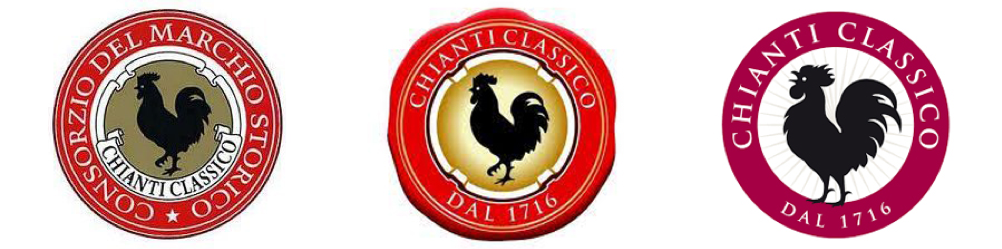
The Consorzio Chianti Classico Logo Through the Years: 1924 - 2013
What the Gallo Nero Means Today
Today, the Black Rooster is way more than just a picture on a bottle. It represents its origin from a clearly defined area between Florence and Siena, wines with a rich history and skilled craftsmanship, guaranteed quality, and that special bond between the landscape, tradition, and winemaking that makes Chianti Classico truly unique.
The rooster means a wine has to follow strict rules: the Sangiovese grape has to be at least 80% of the blend. The rest can be local or international grapes, depending on what the winemakers prefer. This freedom allows for lots of variety, but the Chianti character still shines through.
This blend of tradition, origin, and individual style is what makes the region so exciting. Every place, every altitude, every soil, and every vintage tells its own unique story. And the Gallo Nero always reminds us where this connection comes from.

The Chianti Classico Consorzio currently has 486 members, and 345 of them bottle their own wine (as of February 2024).
A region packed with history – and a symbol that ties it all together.
The Black Rooster is way more than just a logo these days. It's the clear symbol of a wine region that's centuries old, always reinventing itself without forgetting its roots. The legend of the black and white rooster, the Medici's historical decisions, the old rules, the art, the wine philosophy, and the passion of the winemakers – it all comes together in this one symbol.
When you open a bottle of Chianti Classico, you're always opening a piece of history.
A piece of Tuscany.
A piece of identity.
And maybe that's the real reason the Black Rooster has stuck around so much: It reminds us that where something comes from really matters – and that wine sometimes tells a bigger story than what you just see in the glass.